OpenCPI Documentation
The OpenCPI Installation Guide is intended to be used to establish an installation ready for users. It is designed to allow installation without much learning of OpenCPI concepts, and thus this guide is not a prerequisite for that document. A user may need to refer to that document when installation requirements change, but it should not be needed for day-to-day use of OpenCPI. After using the installation guide, the entire installation may be copied to other machines without redoing the installation process.
There are reference manuals for complete descriptions of all supported features and concepts in the different development areas of OpenCPI, namely:
Application development
Component development (in general, regardless of authoring model)
RCC development (C++ workers in libraries)
HDL development (FPGA development)
Platform development (OSP and device support development)
There is also an Glossary of Terms that provides definitions for OpenCPI terms and industry terms used in OpenCPI. The glossary is available both as a stand-alone document and as the last chapter of each reference document (including this one).
If a platform has installation issues beyond the generic installation for its platform type described in the OpenCPI Installation Guide, it has its own Getting Started Guide that describes these platform-specific details.
All assets that can be created in an OpenCPI project with the ocpidev command-line tool can have their own documents (sometimes called datasheets for component specs and workers). The Documentation Writer Guide provides content and format guidelines for creating these documents using the Sphinx-based asset documentation system that is integrated with ocpidev.
A graphical diagram follows showing OpenCPI documentation and how users are expected to use it:
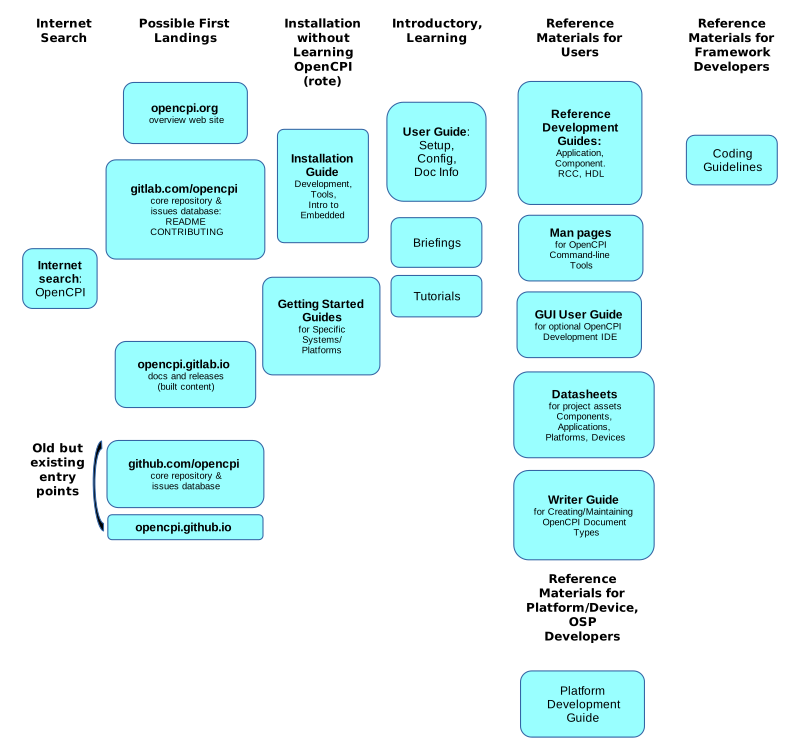
Figure 3: Documentation for OpenCPI