E31x Platform Worker
Functionality
The E31x Platform worker is the interface between the Processing System and the FPGA on the Ettus E310 Platform. It makes the connections between the AXI buses on the ARM and the OpenCPI Control and Data Planes.
Worker Implementation Details
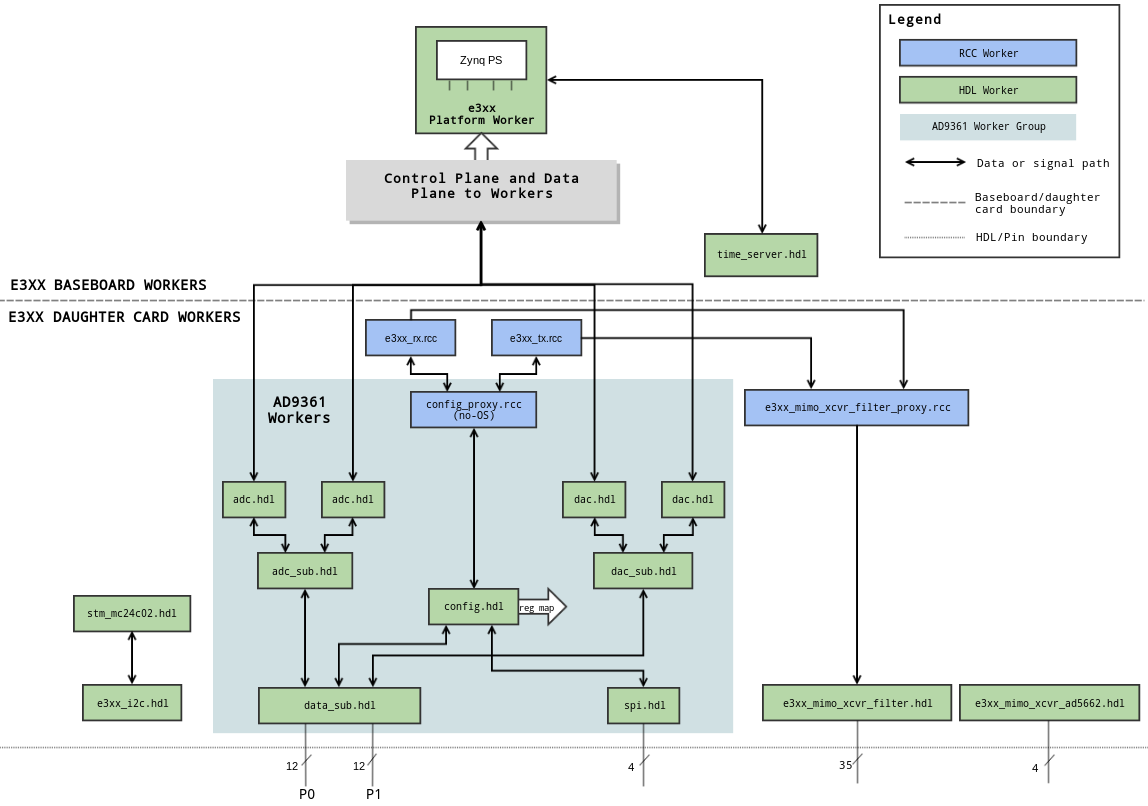
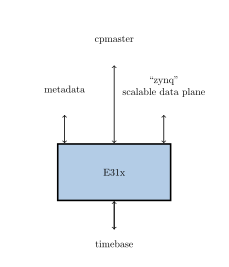
The E31X Platform Worker provides the device, device proxy, and application workers with interfaces to the control and data planes as necessary. The Platform Worker also instantiates and connects to the time_server.hdl device worker. A block diagram of the full Board Support Package, including device workers, device proxy workers, the platform Worker, and their connections is shown below:
Daughterboard
This platform contains a daughterboard which is comprised of an AD9361 RF IC, an analog filter bank along with control signals, and an AD5662 IC. Each of these has one or more device workers and/or a device proxy worker for control. Because the AD9361 device workers are platform-agnostic, they do not contain E310-specific support. More information on each of these workers can be found in its respective data sheet.
Block Diagrams
Top level
State Machines
Various state machines exist in the zynq, axi, and sdp primitive libraries. See primitive library source code for details. The explicit source code files included in the aforementioned primitives are enumerated in the following section.
Component Ports
No ports are implemented for the given component specification.
Worker Properties
sdp_channelsType:
ulongAccess:
Parameter:
TrueWritable:
FalseInitial:
FalseVolatile:
FalseRead back:
False
Default value:
None
use_acpType:
boolAccess:
Parameter:
TrueWritable:
FalseInitial:
FalseVolatile:
FalseRead back:
False
Default value:
None
useGP1Type:
boolAccess:
Parameter:
TrueWritable:
FalseInitial:
FalseVolatile:
FalseRead back:
False
Default value:
None
pps_srcType:
ucharAccess:
Parameter:
TrueWritable:
FalseInitial:
FalseVolatile:
FalseRead back:
False
Default value:
None
axi_errorType:
boolArray dimensions:
['4']
Access:
Parameter:
FalseWritable:
FalseInitial:
FalseVolatile:
TrueRead back:
False
Default value:
None
sdpDropCountType:
ucharAccess:
Parameter:
FalseWritable:
FalseInitial:
FalseVolatile:
TrueRead back:
False
Default value:
None
debug_stateType:
ulonglongArray dimensions:
['4']
Access:
Parameter:
FalseWritable:
FalseInitial:
FalseVolatile:
TrueRead back:
False
Default value:
None
debug_state1Type:
ulonglongArray dimensions:
['4']
Access:
Parameter:
FalseWritable:
FalseInitial:
FalseVolatile:
TrueRead back:
False
Default value:
None
debug_state2Type:
ulonglongArray dimensions:
['4']
Access:
Parameter:
FalseWritable:
FalseInitial:
FalseVolatile:
TrueRead back:
False
Default value:
None
onswitch_db_pType:
boolAccess:
Parameter:
FalseWritable:
FalseInitial:
FalseVolatile:
TrueRead back:
False
Default value:
None
Worker Signals
PPS_EXT_INDirection:
inDifferential:
falsePin:
false
GPS_PPSDirection:
inDifferential:
falsePin:
false
PL_GPIODirection:
outWidth:
6Differential:
falsePin:
false
ONSWITCH_DBDirection:
inDifferential:
falsePin:
false
Worker Devices on E31X MIMO XCVR Card
The following is a table which enumerates which device workers are allowed in platform configurations and in assembly containers. The parameter values specify restricted/allowed implementations. Note that the worker signals listed are only those who are unconnected on the platform or whose platform signal name differ from the worker signal name. Note that device workers allowed by cards are not included in this list.
e31x mimo xcvr ad5662
e31x i2c
e31x mimo xcvr filter
ad9361 spi
Property Name:
CP CLK FREQ HZ p
Property Value:
100e6
ad9361 data sub
Property Name:
lvds p
Property Value:
falseProperty Name:
half duplex p
Property Value:
falseProperty Name:
single port p
Property Value:
trueProperty Name:
swap ports p
Property Value:
false (true also supported)Property Name:
DATA CLK Delay
Property Value:
7Property Name:
RX Data Delay
Property Value:
0Property Name:
FB CLK Delay
Property Value:
12Property Name:
TX Data Delay
Property Value:
0
ad9361 adc sub
Property Name:
lvds p
Property Value:
falseProperty Name:
half duplex p
Property Value:
falseProperty Name:
single port p
Property Value:
true
ad9361 dac sub
Property Name:
lvds p
Property Value:
falseProperty Name:
half duplex p
Property Value:
falseProperty Name:
single port p
Property Value:
true
ad9361 adc0
ad9361 dac0
ad9361 adc1
ad9361 dac1
Control Timing and Signals
Control Domain
All control clocking in the E31X platform originates from the PS7 processing clock 1 (FCLK1), which is set to 100 MHz.
Sampling Domain
The sampling clock domain originates from the AD9361’s DATA_CLK_P output. It is labeled CAT_DATA_CLK on the daughterboard connector, and is ultimately assigned to the E31X_CONN_CAT_DATA_CLK input pin in the constraints file. This clock is routed to the AD9361 device workers (specifically ad9361_data_sub.hdl) via OpenCPI card/slot constructs.
This clock is used by the ad9361_adc_sub.hdl and ad9361_dac_sub.hdl workers. Additionally, the ad9361_dac_sub.hdl generates FB_CLK, which is routed through the card/slot to the E31X_CONN_CAT_FB_CLK output pin in the constraints file. This clock is transmitted alongside TX data in a source synchronous fashion. See the AD9361 device worker documentation and ADI’s UG-570 for more information regarding the relationships between these clocks.
Performance and Resource Utilization
Note that there are many possible configurations of this platform. For each combination of CMOS Single/Dual Port, Half/Full Duplex and ports-swapped/not swapped, there is also a 0rx1tx, 1rx0tx, 1rx1tx, … 2rx2tx. The resource utilization is only listed here for some of these, but can be extracted from the synthesized platform configuration for the supported modes. For now, the only supported modes are those corresponding to CMOS Single Port Full Duplex.
Test and Verification
Testing performed to verify functionality of the Platform Worker includes running of basic unit/application tests to test the Platform Worker itself, as well as device worker unit tests and system level application tests.
To test the basic functionality of the Platform Worker, simple applications such as testbias and unit tests such as bias.test were executed. These verify the basic functionality of the Platform Worker and its communication with the xilinx13_4 Software Platform.
To further test the Platform Worker’s functionality paired with its device workers, device worker unit tests were modified and performed for the AD9361 device workers, the E31X XCVR Filter device worker and proxy, the AD5662 device worker, and the RX and TX proxy workers. Each of these tests has its own document that can be reviewed for further information.
Finally, OpenCPI reference applications were modified and tested on the E310 radio using the AD9361 workers in CMOS Single Port Full Duplex DDR mode. This provides a full system test along the RX and TX paths.