Clock Domain Crossing - Pulse Handshake (cdc_pulse_handshake)
Pulse handshake clock domain crossing (CDC) synchroniser.
Design
Capture an active high pulse on the source clock domain and transfer it to a pulse on the destination clock domain, using clock domain crossing (CDC) synchronisers. Indicate to the source clock domain when it is ready to accept a new pulse input.
Implementation
If a pulse is received on the input signal (src_pulse) but the primitive is not ready to receive it (src_ready is low) then the input signal will be ignored. Alternatively, if the primitive is ready, the src_toggle signal will be inverted and transferred through a single bit synchroniser from the source (src_clk) to the destination (dst_clk) clock domain to generate the dst_toggle signal. An edge detector will monitor this signal and generate a pulse on the output signal (dst_pulse) in the destination clock domain. The dst_toggle signal will be transferred through a single bit synchroniser back to the source clock domain to acknowledge that the pulse has been sent and indicate that the primitive is ready to receive another pulse on the input. The src_toggle signal will be held in a steady state, from when it is applied to the synchroniser until it is acknowledged, i.e. whilst the primitive is indicating it is not ready to receive a new input pulse. This ensures that the pulse will be transferred irrespective of the relationship between the rate of change of the input signal and the destination clock speed.
A block diagram representation of the implementation is given in Figure 479:.
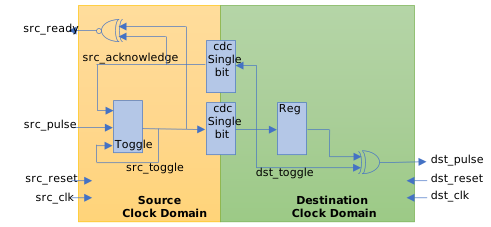
Figure 479: Block diagram of a pulse handshake clock domain crossing (CDC) synchroniser implementation.
Further information on metastability and synchronisation can be found at:
The primitive passes signals between different clock domains and has been designed for that purpose. The primitive may contain attributes and should be paired with constraints to control their placement, optimising the MTBF through the synchronisers, and preventing the timing analyser from needlessly attempting to time the crossing signals. The Xilinx Vivado tool has the capability to report on the quality of the clock domain crossings in the design and can accept waivers for warnings generated for CDC architectures that it can not automatically verify. Platform/application developers should therefore consider adding the constraints, or similar if not using Vivado, to designs that instantiate the primitive. Refer to the documentation for all clock domain clocking primitives identified in the dependencies section, and all of their dependencies.
Interface
Generics
dst_registers_g(natural): Number (2 to 10) of synchronisation registers (defaults to 2). Increase for improved MTBF.
Ports
src_clk(std_logic), in: Source clock. Input registered on rising edge.
src_reset(std_logic), in: Source reset. Active high, synchronous with rising edge of source clock.
src_pulse(std_logic), in: Input active high pulse to be detected and resynchronised.
src_ready(std_logic), out: Output active high indicating ready to receive an input pulse onsrc_pulse.
dst_clk(std_logic), in: Destination clock. Synchronisation registers and output registered on rising edge.
dst_reset(std_logic), in: Active high, synchronous with rising edge of clock.
dst_pulse(std_logic), out: Output active high pulse synchronised to the destination clock.
Dependencies
The dependencies to other elements in OpenCPI are:
There is also a dependency on:
ieee.std_logic_1164
ieee.numeric_std
Limitations
Limitations of cdc_pulse_handshake are:
None